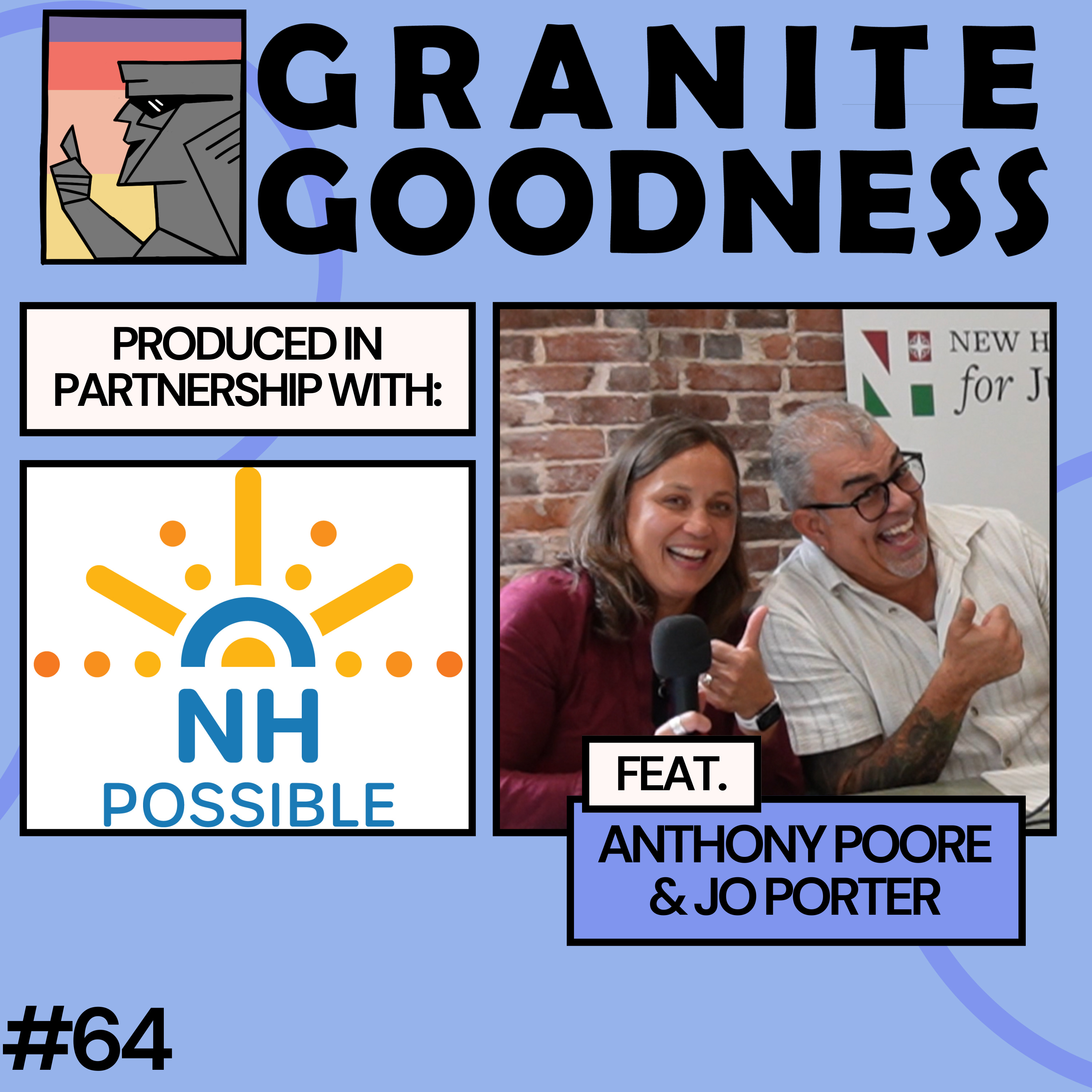
If you wander into the New Hampshire Center for Justice and Equity, you might think you walked into an art studio by accident.
The walls bloom with color. Vibrant stickers of civil rights heroes sit in little piles like treasure. Somewhere in the background Anthony is talking about how joy is not an accessory to justice but the thing that keeps the whole machine from collapsing. His friend and colleague Jo nods, partly because she agrees, partly because she just refilled the candy bowl.
This episode is less a policy chat and more an orbit around two people trying to bend a state toward belonging. We talk about the window of opportunity for justice work following 2020. We talk about why New Hampshire is not as simple or as monochrome as people imagine. We talk about identity and why the words we choose for ourselves matter, even if they sometimes confuse our relatives at Thanksgiving.
Also, today is Giving Tuesday. If you enjoy this conversation and feel inspired by Anthony and Jo (I know I do) consider checking out their site and making a donation at nhcje.org/donate.
Anthony Poore is the President & CEO at the NH Center for Justice and Equity
Jo Porter the Chief Strategy Officer at the NH Center for Justice and Equity
This episode was produced in partnership with NH Possible, focusing on the NH Center for Justice and Equity. Learn more about them at nhpossible.org and nhcje.org
NH Possible is a collaboration between:
Health Strategies of NH
NH Health Cost Initiative
HealthForce NH
Foundation for Healthy Communities
NH Center for Justice & Equity
NH Fiscal Policy Institute
and NH Businesses for Social Responsibility
Together, they are building a statewide movement envisioning a New Hampshire where individuals, families, communities and businesses all have what they need to thrive, including a sense of belonging, opportunities for civic engagement, optimal health, and access to educational and financial opportunity.
This episode is shared in partnership with our friends at NH Rocks!
Music provided by Sneaky Miles
Episode Summary*
For people who may not know you yet, how would you describe what the New Hampshire Center for Justice and Equity is and why it was created?
Anthony: The Center grew out of the Race and Equity in New Hampshire series. Hundreds of people came together to look honestly at how race and racism were affecting health, opportunity, and daily life. The findings were not good, and it became clear that we needed more than a one-time report. We needed an institution dedicated to addressing the systems creating those outcomes. When no existing group could take it on, the Endowment for Health asked us to build something new. We launched the Center so that the work would not fade when the headlines did.
Jo: I came in through the health work group. I realized I wanted to do more than observe the problem. I wanted to be part of the solution. Leaving a fifteen year career at UNH was scary, but it felt like the right decision. I wanted to help build something that could actually move the needle for people.
When you talk to Granite Staters who are not immersed in equity work, how do you help them understand what you do?
Anthony: I start with the fact that most people want the same things. Safety, dignity, opportunity. Equity work is about making sure the systems in this state give everyone access to those things. When someone is frustrated about housing, schools, or health care, there is usually a systems issue beneath it. Once you see that, equity stops feeling theoretical.
Jo: And we remind people that their struggles are not isolated. Communities across the state deal with the same pressures, whether economic or social. When we talk about the root causes together, the conversation shifts. It becomes less about calling people racist and more about understanding why certain patterns keep showing up and how we fix them.
What do you want people to understand about New Hampshire’s demographics today?
Anthony: The facts tell a different, more diverse story about who lives here. We have about 1.4 million people in the state, and nearly a quarter of a million are people of color. They live in all ten counties. Many are bilingual and working age, which strengthens our workforce and communities. Ignoring their experiences would mean ignoring a significant part of New Hampshire.
How do you respond when you hear statements like, “I do not see why racism still matters. I am not personally prejudiced and do not know anyone who is.”?
Anthony: People confuse racism with privilege. You can be a white person from the North Country who lost their job when the paper and pulp mills closed and still be struggling. That is real. But that does not erase the fact that people of color often face challenges that are outside their control. Multiple truths can exist at once.
Jo: A lot of folks only associate racism with the big, visible acts from our past. They do not think about systemic things like discriminatory lending, or the data patterns in homeownership, health, or education. When we talk about those, people begin to see why this work is ongoing.
You both talk a lot about joy. Why is joy part of the work?
Anthony: This work is emotionally heavy. Joy is what keeps communities going. I think of it like an emotional savings account. When we invest in art, music, gatherings, and connection, those become deposits we draw on during hard moments.
Jo: And there is joy in community, even when the conversations are hard. Being with people who understand the work makes the burden lighter.
Do people generally think your work only touches on racial issues? Or do they have an awareness of the breadth of it?
Jo: It varies! Our work touches disability rights, LGBTQ+ issues, economic justice, and more. Identity has many layers. Race is one dimension, but it is not the whole story.
Anthony: The goal is not to be the organization for one group. It is to create what I call a tent with no walls. No matter who you are, you should be able to step inside and feel welcomed.
Identity and language comes up a lot in these conversations. Why do words matter so much?
Jo: Because being seen matters. I grew up filling out demographic forms that had no category for me. When language finally acknowledges you, it tells you that your community sees you. That is powerful.
Your organization is a part of NH Possible. What made you want to be part of that effort?
Anthony: NH Possible is a reminder that there are many Granite Staters working hard on the issues. It brings together partners who believe progress is still achievable in New Hampshire. For us, that alignment matters. The work is hard, so having a community of people determined to move forward together is energizing.
Jo: And it feels honest. NH Possible is about creating spaces where people can think together, imagine together, and take action before things hit crisis levels. That is exactly what we try to do. It is grounded optimism, and we are drawn to that.
When you look at New Hampshire right now, what gives you optimism?
Anthony: The quiet majority. The people who show up wanting fairness, safety, and connection. They far outnumber the folks who yell the loudest.
Jo: The commitment we see every day. People who want to understand, to collaborate, and to make this a place where everyone can thrive. That dedication gives me hope for where we can go as a state.
*The questions, wording, and phrasing in this summary may differ slightly from the original conversation. We provide these summaries to give subscribers a brief, accessible synopsis of the episode. Full episode transcripts are available on granitegoodness.com.
Thanks for listening! Don’t forget to check out our latest good news newsletters for NH or New England.
-Andy
Too many emails from us? Change your suscriber preferences here or email me at hello@granitegoodness.com with any questions.


